Crossbench
ApprovedCurrentElection
Title

SNP remains the largest party but short of a majority as Reform UK enters Holyrood

Date
7 May 2026
Relevant topic(s)
Electoral systemsDifferent electoral systemsElectoral systemsElectoral system analysisPolitical partiesEmerging and minor UK political partiesThe constitutionThe role and powers of devolved bodies in the UK, and the impact of devolution on the UK

What happened?

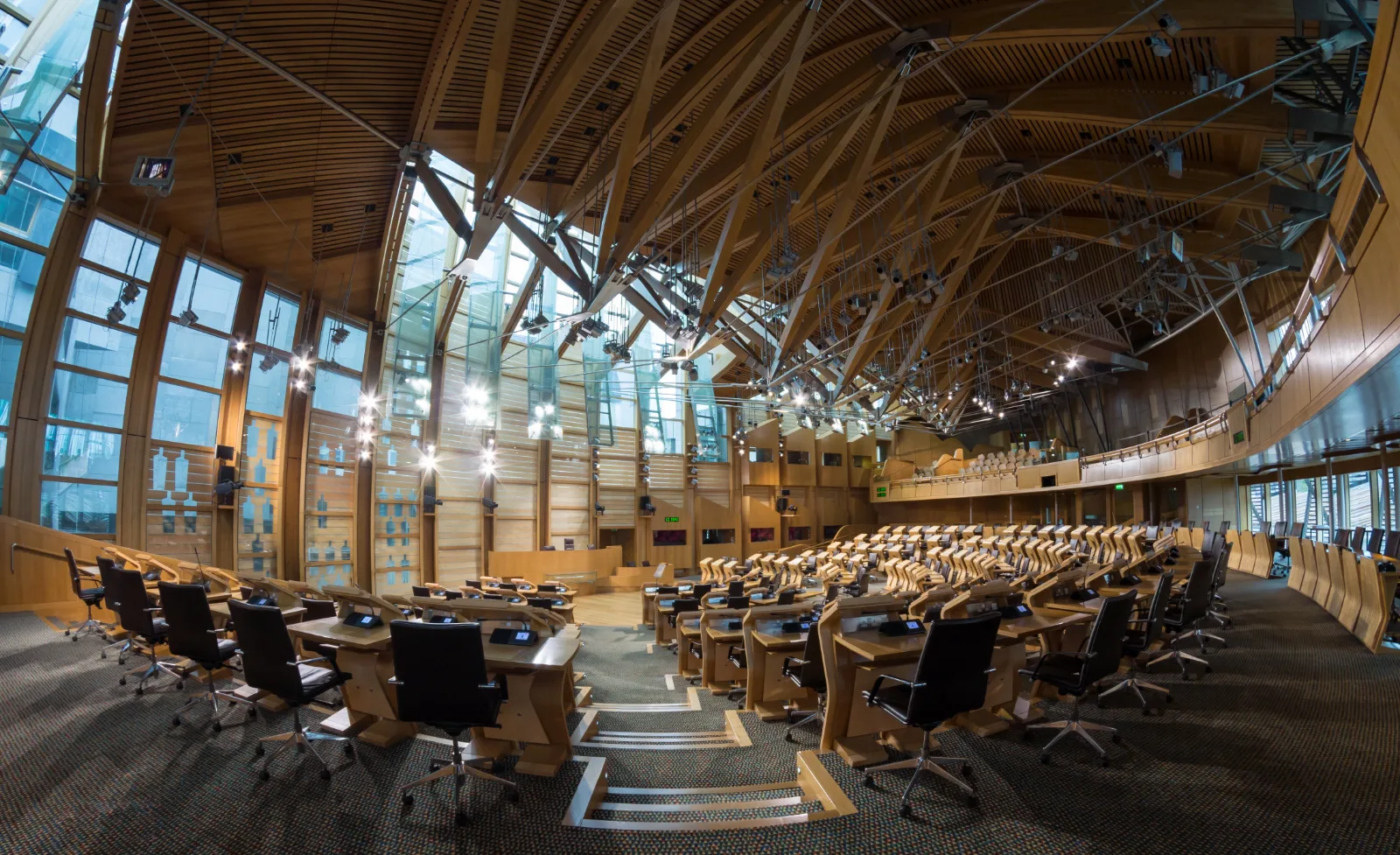
Holyrood
Photo: Original photo by Colin, CC BY 4.0

On 7 May 2026 Scotland elected its 129-member Parliament using the Additional Member System: 73 MSPs chosen in single-member constituencies by first past the post and 56 from regional party lists, with regional seats allocated so as to bring each party’s share of seats closer to its share of the vote. The election was held on the same day as Wales’s first closed-list Senedd election.

The SNP won 58 seats, six fewer than in 2021 and seven short of a majority. Reform UK won its first seats in the Parliament, tying with Labour on 17, while the Greens rose to 15, the Conservatives fell to 12 and the Liberal Democrats rose to 10. On 19 May the Parliament selected John Swinney as First Minister after three rounds of voting, and he said he would lead a minority SNP government.

  • Scotland has 73 constituencies, each electing one MSP, and 8 regions, each electing seven regional MSPs, making 129 in all. Each voter has two votes, and regional seats are allocated by a formula intended to make each party’s share of seats in a region roughly match its share of the regional vote.
  • Seats won on 7 May 2026: SNP 58, Labour 17, Reform UK 17, Scottish Greens 15, Conservatives 12, Liberal Democrats 10. A majority requires 65 seats.
  • Compared with 2021, the SNP lost 6 seats, Labour 5 and the Conservatives 19 (from 31, their lowest total since devolution); the Greens gained 7, the Liberal Democrats 6 and Reform UK 17.
  • It was the first time Reform UK had been elected to the Scottish Parliament. All 17 of its seats came from the regional lists; it won no constituency despite 15.8% of the constituency vote.
  • The SNP won 57 of the 73 constituencies but only 1 regional seat.
  • Regional list vote shares: SNP 27.2% (down 13.2 points), Reform UK 16.6%, Labour 16.0%, Greens 14.0%, Conservatives 11.8%, Liberal Democrats 9.4%.
  • Constituency vote shares: SNP 38.2%, Labour 19.2%, Reform UK 15.8%, Conservatives 11.8%, Liberal Democrats 11.4%, Greens 2.3% (the Greens stood in 6 of the 73 constituencies). The SNP’s share was down 9.5 points on 2021.
  • 2,309,063 people voted. Turnout was 53.1% in the constituency vote and 53.2% in the regional vote, down from 63.5% in 2021 and around the average for Scottish Parliament elections since 1999.
  • The Electoral Reform Society calculated a Loosemore–Hanby deviation from proportionality of 17.8, the highest of any Scottish Parliament election, against an average of 10.7 for the first six; the SNP won 45% of seats on 27.2% of the list vote.
  • Before the election John Swinney said that an SNP majority of 65 seats was the route to a second independence referendum.
  • On 19 May 2026 all six party leaders stood for nomination as First Minister. John Swinney was selected in the third round of voting with 56 votes, and was sworn in at the Court of Session on 20 May 2026.
  • The First Minister said his government would rule as a minority government, seeking support from other parties case by case, including for budgets.
  • On 26 May 2026 the Parliament agreed by 72 votes to 55, after accepting a Scottish Green amendment, a government motion calling on the UK Government to make a Section 30 order under the Scotland Act 1998 to devolve the power to hold an independence referendum.
  • A Downing Street spokesperson responded that the UK Government does not support independence or another referendum.
Seats won at the 2026 Scottish Parliament election
  • SNP58
  • Labour17
  • Reform UK17
  • Greens15
  • Conservatives12
  • Liberal Democrats10

129 seats in total; 65 are needed for a majority.

Why is it politically significant?

The result shows how the two halves of the Additional Member System interact. The SNP’s dominance of the constituencies gave it almost all its seats, while the regional lists gave Reform UK, the Greens and Labour most of theirs. Students can use it both to show that the list tier helps smaller and emerging parties and to show that it cannot fully correct a large constituency advantage.

It also shows devolution at work. No party won a majority, so the First Minister was chosen over several rounds of voting and governs as a minority, relying on other parties for support. The Parliament then used its new composition to call for a Section 30 order, which the UK Government rejected, showing the limits of devolved power over the constitution.

How to use

Which arguments does it support?

The Additional Member System gives smaller and emerging parties fairer representation than first past the post

Reasoning
The regional list tier allocates seats with reference to each party’s share of the regional vote.
Evidence
Reform UK won no constituencies on 15.8% of the constituency vote but gained 17 regional seats on 16.6% of the list vote; the Greens won 13 of their 15 seats from the lists.
How it supports the argument
Under first past the post alone, Reform UK would have won no seats despite winning around one vote in six.

Proportional elements in an electoral system make single-party majorities less likely

Reasoning
When seats more closely follow votes, a party needs a very large share of the vote to win a majority on its own.
Evidence
The SNP won 58 of 129 seats, seven short of a majority, and the First Minister said he would lead a minority government seeking support case by case.
How it supports the argument
The system produced the negotiated form of government that supporters and critics of proportional representation both expect.

Emerging parties are breaking through in UK politics

Reasoning
The rise of Reform UK across Great Britain challenges the established parties.
Evidence
Reform UK was elected to the Scottish Parliament for the first time and tied with Labour for second place, while the Conservatives fell from 31 seats to 12.
How it supports the argument
A party with no MSPs in 2021 became joint second largest, largely at the expense of an established party.

Devolution has created continuing tension over the constitution

Reasoning
The devolved Parliament can express a view on independence but the power to hold a referendum is reserved to Westminster.
Evidence
The Parliament voted 72 to 55 for a Section 30 order, and Downing Street said the UK Government does not support another referendum.
How it supports the argument
A majority in the devolved Parliament could request, but not obtain, the power to hold a referendum.

Which counterarguments exist?

Limits of the evidence

The result was the least proportional in the Parliament’s history

The Electoral Reform Society calculated that the 2026 result had the highest deviation from proportionality of any Holyrood election: the SNP won 45% of seats on 27.2% of the list vote, because its 57 constituency wins exceeded what its list vote alone would have earned.

A different conclusion

Even so, AMS was far more proportional than first past the post

The same analysis found the result more proportional than every UK general election in Scotland from 2001 to 2024, so it can also be used to argue that AMS outperforms first past the post.

Alternative view

The election did not give a clear mandate for an independence referendum

Swinney had said before the election that an SNP majority was the route to a referendum, and the SNP fell short of one. Supporters of the Section 30 motion pointed to the pro-independence majority of SNP and Green MSPs, while Labour and Conservative leaders criticised the focus on independence and Downing Street rejected another referendum.

Other explanations

Lower turnout limits what the result shows

Turnout fell from 63.5% in 2021 to about 53%, close to the long-run average, so comparisons with 2021 may partly reflect who voted rather than only changes in party support.

Concepts and connections

Sources and verification

Event7 May 2026
Added to bank8 November 2026
Last checked8 November 2026
Next check due8 May 2027
  1. 3
    Publisher Scottish ParliamentPublished not statedType Official guidanceChecked 4 November 2026
    Opened
  2. 1
    Publisher Scottish ParliamentPublished 2026-05-08Type DataChecked not yet opened
    Source to check
  3. 2
    Publisher Scottish Parliament Information Centre (SPICe)Published 12 May 2026 (republished 15 May 2026)Type Research briefingChecked 4 November 2026
    Opened
  4. 4
    Publisher SPICe Spotlight (Scottish Parliament Information Centre)Published 2026-05-09Type ReportChecked not yet opened
    Source to check
  5. 6
    Publisher SPICe Spotlight (Scottish Parliament Information Centre)Published 2026-05-28Type DataChecked not yet opened
    Source to check
  6. 5
    Publisher Electoral Reform SocietyPublished 2026-05-14Type ReportChecked not yet opened
    Source to check
  7. 8
    Publisher New StatesmanPublished 2026-05-09Type NewsChecked not yet opened
    Source to check
  8. 7
    Publisher STV NewsPublished 2026-05-13Type NewsChecked not yet opened
    Source to check
  9. 9
    Publisher Scottish ParliamentPublished 2026-05-19Type OfficialChecked not yet opened
    Source to check
  10. 10
    Publisher SPICe Spotlight (Scottish Parliament Information Centre)Published 2026-05-20Type ReportChecked not yet opened
    Source to check
  11. 11
    Publisher STV NewsPublished 19 May 2026Type NewsChecked 4 November 2026
    Opened
  12. 12
    Publisher Scottish ParliamentPublished 2026-05-26Type OfficialChecked not yet opened
    Source to check
  13. 13
    Publisher HolyroodPublished 2026-05-26Type NewsChecked not yet opened
    Source to check
  14. 14
    Publisher STV NewsPublished 2026-05-26Type NewsChecked not yet opened
    Source to check

About this example

Is it still current?

Current

The facts and their significance still stand.

Why it is in the bank

The most recent Scottish Parliament election shows the Additional Member System at work, Reform UK’s first breakthrough at Holyrood and a minority devolved government.

  • ✓Relevance to the specification
  • PartlyStrength and reliability of the evidenceConstituency vote shares for the SNP, Conservatives and Liberal Democrats come from the Electoral Reform Society, as the Parliament’s briefing text gives only their changes; the Electoral Commission’s report on the election had not been checked.
  • ✓Importance to a wider political debate
  • ✓Usefulness in evaluative essays
  • ✓Connections to other topics
  • ✓Sufficiently current
  • ✓Adds something new to the bank

Editorial status

Approved

Signed off for students.

Origin: Human-written · Reviewer: Editor

Every fact on this page has been checked against original sources.