Crossbench
ApprovedDevelopingInternational
Title

Security Council divides over the 2026 war involving Iran, the United States and Israel

Date
28 February 2026 onwards (Resolution 2817 on 11 March; veto on 7 April)
Relevant topic(s)
Global governance: politicalPolitical: the United Nations and NATOGlobal governance: politicalHow far these institutions address and resolve contemporary global issuesPower and developmentsDiffering significance of states in global affairsPower and developmentsPolarityComparative theoriesHow far realism and liberalism explain developments since 2000

What happened?

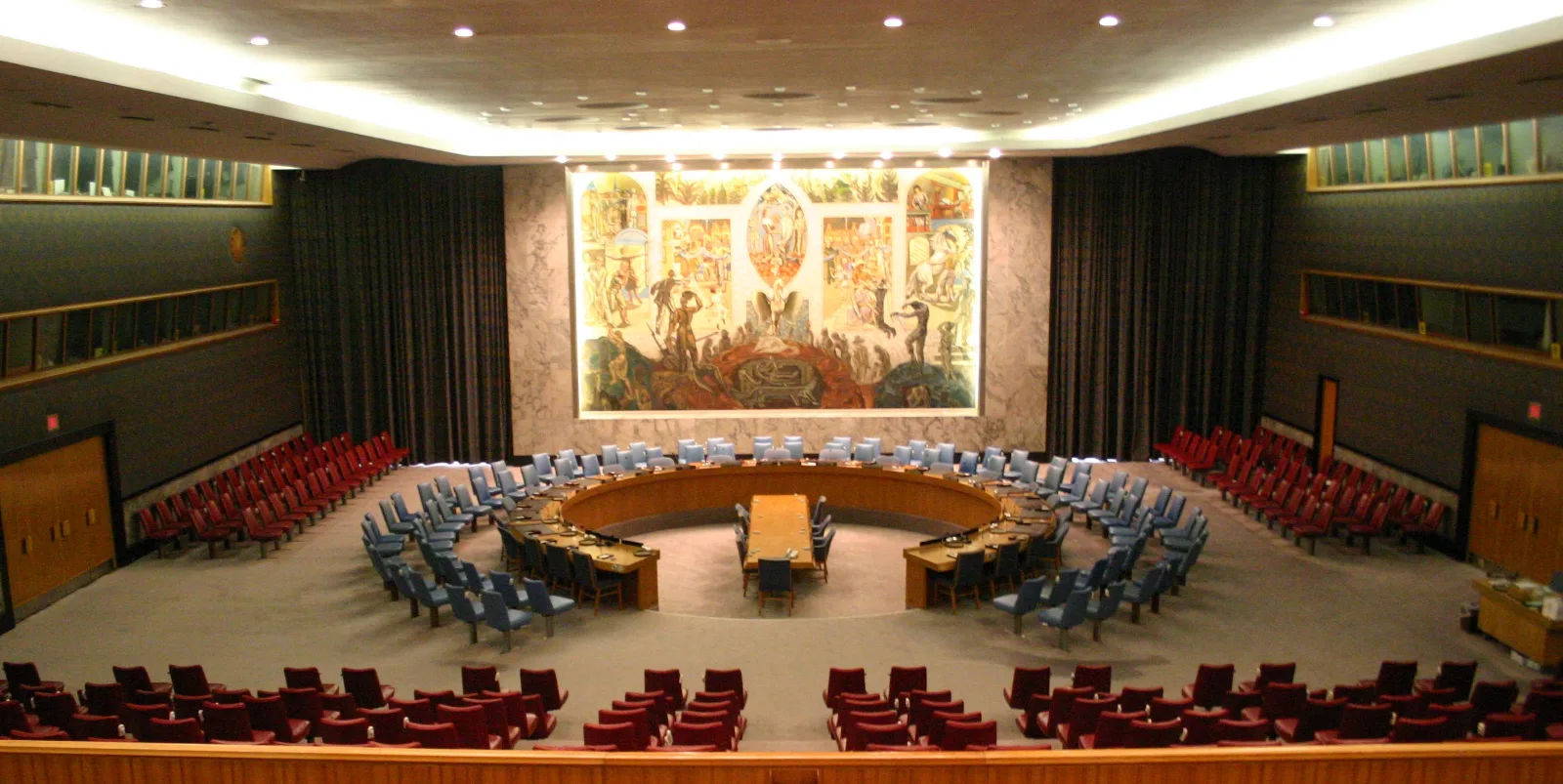
UN Security Council
Photo: Original photo by Patrick Gruban, CC BY 2.0

On 28 February 2026 the United States and Israel launched strikes on Iran. Iran responded with attacks on Israel, on US bases in the Gulf and on Gulf states, and moved to close the Strait of Hormuz, a key route for world oil supplies. The UK did not take part in the first strikes, but agreed that the US could use British bases for what the government called limited defensive operations.

The UN Security Council adopted Resolution 2817 on 11 March condemning Iran’s attacks on its neighbours, with China and Russia abstaining. On 7 April China and Russia vetoed a further draft on shipping in the strait, arguing that it ignored the US and Israeli strikes. A ceasefire in April and a US–Iran memorandum in June were followed by renewed fighting from late June. By November 2026, talks through mediators were continuing, but the strait remained largely closed.

  • The United States and Israel launched strikes on Iran on 28 February 2026. The Security Council held an emergency meeting the same day, at which the Secretary-General said the strikes followed indirect US–Iran talks mediated by Oman.
  • At the 28 February meeting, the UN reported that Iran had responded with strikes on Israel and on US military bases in Gulf countries.
  • Iran told ships on 28 February that it was closing the Strait of Hormuz, and on 2 March a senior adviser to the commander of the Revolutionary Guards said ships trying to pass would be attacked. Reuters noted that about a fifth of the world’s daily oil consumption passes through the strait.
  • On 2 March 2026 the Prime Minister told the House of Commons that the UK had not taken part in the initial strikes, and that it had agreed a US request to use British bases for a “specific, limited defensive purpose”: destroying Iranian missiles at source. He said this rested on the collective self-defence of allies.
  • On 11 March 2026 the Security Council adopted Resolution 2817 by 13 votes to none, with China and Russia abstaining. Drafted by Bahrain and co-sponsored by nearly 140 states, it condemned Iran’s attacks on Bahrain, Kuwait, Oman, Qatar, Saudi Arabia, the United Arab Emirates and Jordan, and demanded that Iran stop interfering with maritime trade.
  • At the same meeting a Russian draft calling for de-escalation without naming any party was not adopted: 4 votes in favour, 2 against (Latvia and the United States) and 9 abstentions, including France and the United Kingdom.
  • On 20 March 2026 UK ministers agreed that the US could use UK bases for “defensive operations” to degrade Iranian missile sites being used to attack ships in the Strait of Hormuz, while calling for urgent de-escalation.
  • Reuters reported that the bases covered by the 20 March decision included RAF Fairford and Diego Garcia.
  • On 7 April 2026 a draft resolution on the Strait of Hormuz, submitted by Bahrain with Jordan, Kuwait, Qatar, Saudi Arabia and the UAE, received 11 votes in favour but was vetoed by China and Russia; Colombia and Pakistan abstained. It would have encouraged states to coordinate defensive efforts, including escorts for merchant ships, and demanded that Iran stop attacks on shipping.
  • The Associated Press reported that earlier versions of the draft would have authorised “all necessary means” to keep the strait open, and that this was dropped after objections from Russia, China and France.
  • A two-week US–Iran ceasefire, mediated by Pakistan, was announced on 8 April 2026.
  • On 14 June 2026 the Secretary-General welcomed a US–Iran deal that, according to his spokesman, provided for an immediate and permanent ceasefire, the reopening of the Strait of Hormuz and a framework for further negotiations.
  • ABC News reported that the agreement was a memorandum of understanding, announced on 15 June, providing for a 60-day halt to fighting and the reopening of the strait, with detailed nuclear talks still to come.
  • A UN record of a Council meeting on 2 July 2026 describes drone strikes on two ships near the strait on 25 June, US strikes on Iranian coastal military sites on 26–27 June, and Iranian attacks on US military sites in Kuwait and Bahrain on 28 June. Indirect talks hosted by Qatar began in Doha on 30 June.
  • At the 2 July meeting, Bahrain said Iran must fully comply with Resolution 2817, and speakers referred to a UK–French-led multinational defensive mission to protect shipping.
  • Al Jazeera reported that hostilities between the US and Iran resumed in July, that the US was operating a naval blockade of Iranian ports, and that in August Iran said the strait would not reopen until its conditions were accepted.
  • China and Russia vetoed a US-backed draft on a sanctions panel of experts on Iran in September 2026. The General Assembly debated the veto on 1 October under its 2022 veto initiative.
  • On 2 November 2026 the US carried out limited “defensive” strikes on Iranian targets in the Strait of Hormuz, according to a US official. AP reported these were the first known US attacks since early September, with Qatari mediators holding talks with Iranian officials.
  • On 3 November a senior Iranian official told Reuters that the two sides remained far from a deal. Iran said the strait would reopen only once conditions including an end to the US naval blockade, oil sanctions relief and the release of frozen funds were met.
The war and the Security Council, 2026
  1. 28 FebruaryUS and Israeli strikes on Iran; Iran retaliates and moves to close the Strait of Hormuz. Emergency Council meeting.
  2. 2 MarchPrime Minister tells the Commons the UK took no part in the strikes but will allow limited defensive US use of British bases.
  3. 11 MarchResolution 2817 adopted, 13–0, with China and Russia abstaining.
  4. 20 MarchUK agrees US use of its bases against missile sites attacking ships in the strait.
  5. 7 AprilChina and Russia veto a draft resolution on the Strait of Hormuz (11 in favour).
  6. 8 AprilTwo-week US–Iran ceasefire announced, mediated by Pakistan.
  7. Mid-JuneUS–Iran memorandum announced; welcomed by the Secretary-General on 14 June.
  8. 25–28 JuneRenewed attacks on shipping and exchanges of strikes; Doha talks begin on 30 June.
  9. July–AugustHostilities resume; US naval blockade of Iranian ports; talks stall.
  10. September–1 OctoberChina and Russia veto a draft on an Iran sanctions panel; General Assembly debates the veto.
  11. 2–3 NovemberLimited US strikes near the strait; Qatari-mediated talks continue with no deal.

Why is it politically significant?

The Council could act when the permanent members did not block it: Resolution 2817 passed because China and Russia abstained rather than voting against. But on the strait itself, which the US and Gulf states treated as the most urgent issue, China and Russia used the veto, as they did again in September on an Iran sanctions panel. The result shows how far the Council depends on agreement, or at least restraint, among its five permanent members.

The main steps towards ending the fighting, the April ceasefire and the June memorandum, were negotiated outside the Council, through states such as Pakistan and Qatar, with the UN welcoming and supporting them. The war is a test of how far global governance can resolve a conflict in which a permanent member is a party, and of whether realist or liberal ideas better explain the behaviour of the states involved.
How to use

Which arguments does it support?

The veto limits the Security Council’s ability to resolve conflicts

Reasoning
Any permanent member can block a resolution, however many other members support it.
Evidence
The 7 April draft on the Strait of Hormuz received 11 votes in favour but was vetoed by China and Russia; a draft on an Iran sanctions panel was also vetoed in September.
How it supports the argument
The Council could not agree a response to the closure of one of the world’s main shipping routes.

Realism explains state behaviour better than liberalism

Reasoning
Realists argue that states act on power and security interests, and that institutions only work when great powers allow them to.
Evidence
Council votes divided along the lines of the permanent members’ alignments, and Resolution 2817’s demands were not met: Bahrain told the Council in July that Iran must comply with it, and the strait remained largely closed in November.
How it supports the argument
Military force and bargaining between states, rather than Council decisions, shaped the course of the war.

Global power is contested between rival great powers

Reasoning
Polarity describes how power is distributed between major states.
Evidence
The US backed the Gulf states’ drafts, while China and Russia abstained on one and vetoed another, saying they ignored the US and Israeli strikes.
How it supports the argument
Disagreement between permanent members reflects a divided international order rather than one dominant power.

Which counterarguments exist?

Alternative view

The vetoed drafts were one-sided

China and Russia argued that the drafts treated Iran as the only source of tension and did not mention the US and Israeli strikes, which China said had no Council authorisation. On this view, the veto prevented an unbalanced text rather than blocking a solution.

A different conclusion

The Council still acted

Liberals can point out that Resolution 2817 passed with no votes against and nearly 140 co-sponsors, and that after each veto the General Assembly’s veto initiative required a public debate. The UN system therefore registered broad international opinion even when the Council was divided.

Other explanations

Diplomacy worked alongside the UN

The April ceasefire and the June memorandum came from mediation by states such as Pakistan and Qatar, which the Secretary-General welcomed. Some argue that the UN’s role in such conflicts is to support negotiations rather than to impose a settlement.

Limits of the evidence

A developing and partly reported picture

The war was continuing at the last check. Many details of the fighting and talks come from news reports rather than official records, and sources differ on some dates, such as when the June memorandum broke down.

Concepts and connections

Sources and verification

Event28 February 2026 onwards (Resolution 2817 on 11 March; veto on 7 April)
Added to bank8 November 2026
Last checked8 November 2026
Next check due8 May 2027
  1. 2Source to check
  2. 1
    Publisher UN NewsPublished 2026-02-28Type OfficialChecked not yet opened
    Source to check
  3. 3Source to check
  4. 4
    Publisher GOV.UK (Prime Minister’s Office)Published 2026-03-02Type OfficialChecked not yet opened
    Source to check
  5. 5Source to check
  6. 6
    Publisher GOV.UKPublished 2026-03-20Type OfficialChecked not yet opened
    Source to check
  7. 16Source to check
  8. 7
    Publisher UN NewsPublished 2026-04-07Type OfficialChecked not yet opened
    Source to check
  9. 17Source to check
  10. 8Source to check
  11. 9
    Publisher UN NewsPublished 2026-06-14Type OfficialChecked not yet opened
    Source to check
  12. 10
    Publisher ABC NewsPublished 2026-06-15Type NewsChecked not yet opened
    Source to check
  13. 11Source to check
  14. 12
    Publisher Al JazeeraPublished 2026-08-13Type NewsChecked not yet opened
    Source to check
  15. 13
    Publisher UN NewsPublished 2026-10-01Type OfficialChecked not yet opened
    Source to check
  16. 14Source to check
  17. 15Source to check

About this example

Is it still current?

Developing

At the last check (8 November 2026), indirect US–Iran talks through Qatari mediators were continuing without a deal. Iran said the Strait of Hormuz would stay closed until its conditions were met, the US naval blockade of Iranian ports remained in place, and the US carried out limited strikes on 2 November.

Why it is in the bank

A current case of the Security Council both acting and being blocked by the veto over a war involving a permanent member, with a direct UK angle through the use of British bases.

  • ✓Relevance to the specification
  • PartlyStrength and reliability of the evidenceSeveral press.un.org pages, including the record of the September sanctions-panel vote, could not be opened in this run; later events rely on Reuters, AP and Al Jazeera reports, some read through republishing sites.
  • ✓Importance to a wider political debate
  • ✓Usefulness in evaluative essays
  • ✓Connections to other topics
  • ✓Sufficiently current
  • ✓Adds something new to the bank

Editorial status

Approved

Signed off for students.

Origin: Human-written · Reviewer: Editor

Every fact on this page has been checked against original sources.