Crossbench
ApprovedDevelopingEvent
Title

Burnham reorganises the centre of government

Date
21 July 2026 (changes announced); 1 September 2026 (Prime Minister’s statement to the Commons)
Relevant topic(s)
Prime Minister and executiveThe structure, role and powers of the executivePrime Minister and executiveThe Prime Minister and the cabinetPrime Minister and executiveThe concept of ministerial responsibilityRelations between the branchesThe relationship between the executive and ParliamentRelations between the branchesThe Supreme Court and its interactions with, and influence over, the legislative and policy-making processes

What happened?

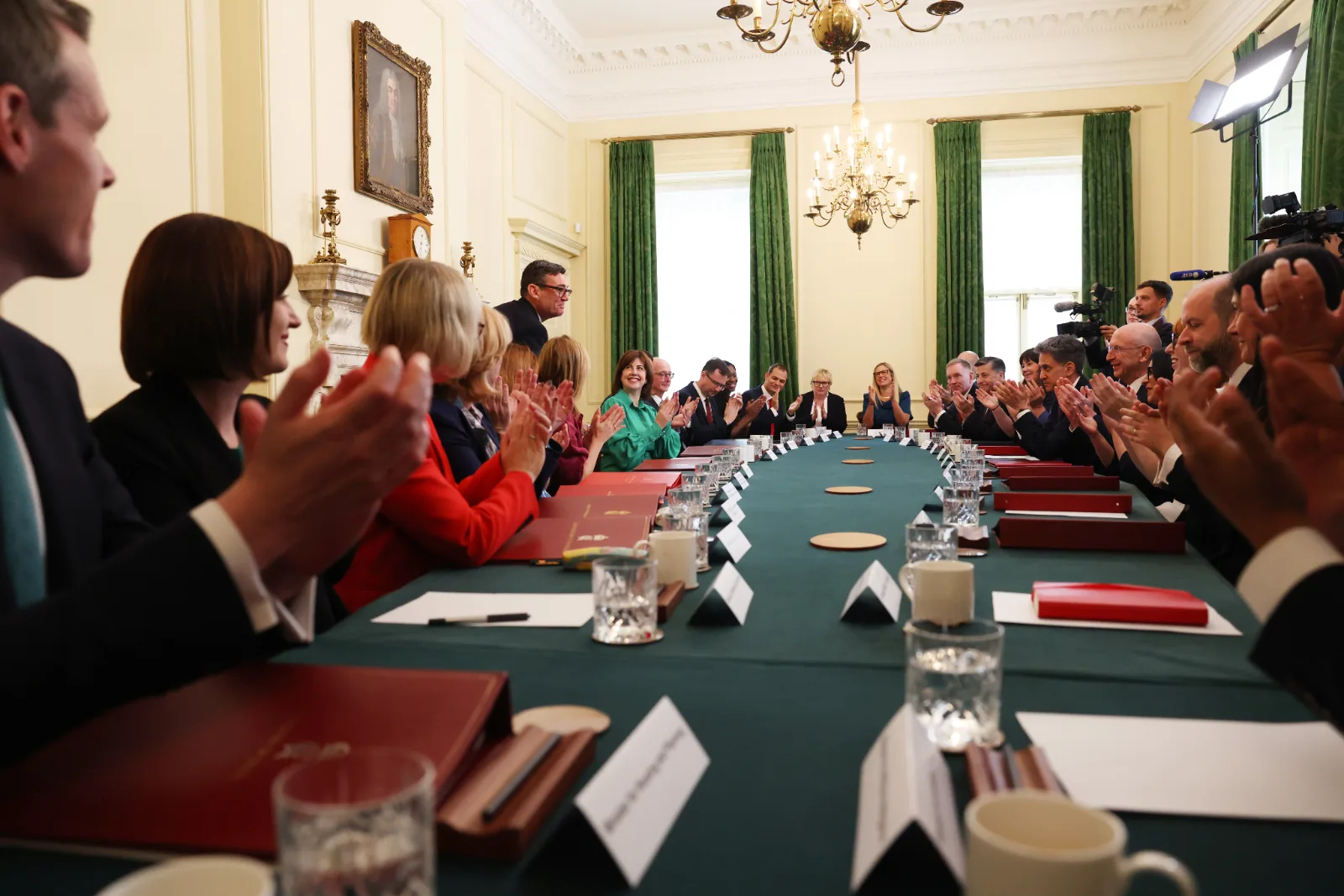
Burnham's first cabinet
Photo: Original photo by Lauren Hurley / No 10 Downing Street, CC BY 4.0

On his first full day as Prime Minister in July 2026, Andy Burnham announced a reorganisation of central government. A new Office for the Prime Minister and Cabinet brought together No.10, a new No.10 North in Manchester and the parts of the Cabinet Office that serve the Prime Minister and Cabinet. No.10 North took over responsibility for devolution and local growth, and the Department for Science, Innovation and Technology was broken up, with its work shared between other departments and the Cabinet Office.

When Parliament returned on 1 September 2026, Burnham set out his plans in his first Commons statement as Prime Minister, offering devolution deals to all parts of England without devolved power. In the following days ministers told colleagues that judicial review was “out of balance” and that ministers should take responsibility for decisions, and announced an end to routine consultations, which the government said helped to “outsource accountability”.
  • The machinery of government changes were announced on 21 July 2026 in a written statement made by Baroness Smith of Basildon on behalf of the Prime Minister, who said they would take effect “from today” where possible.
  • The Office for the Prime Minister and the Cabinet houses No.10, No.10 North and the core Cabinet Office functions that serve the Prime Minister and Cabinet, together with a new AI Taskforce.
  • The new office is led by the Cabinet Secretary, Dame Antonia Romeo, and was described by a Cabinet Office minister as overseen directly by the Prime Minister and the First Secretary of State.
  • No.10 North was set up to lead devolution and local growth, taking local economic growth and devolution strategy from the housing and communities ministry and local economic growth policy from the Treasury.
  • No.10 North is led by Louise Haigh, who is also First Secretary of State and Chancellor of the Duchy of Lancaster; its interim base is Heron House in Manchester.
  • The functions of the Department for Science, Innovation and Technology were redistributed: the Department for Business and Trade became the Department for Business, Innovation, Science and Trade; the culture department took on telecoms, media and the Government Digital Service; and AI strategy and the AI Security Institute moved to the Cabinet Office.
  • A new OneGov Delivery Agency was created to run Cabinet Office operational services, such as recruitment, pensions and security vetting, at arm’s length.
  • The Rewiring the State Cabinet statement of 31 July 2026 said central government “must become smaller and more strategic”, adopted “devolving by default”, under which Secretaries of State must justify keeping functions at the centre, and said arm’s-length body functions could be returned to departments or passed to local leaders.
  • In his Commons statement on 1 September 2026, Burnham said No.10 North “will oversee the rewiring of the British state”, asked it to begin work on a devolution deal for Cornwall, and extended the same offer to all parts of England without devolved power.
  • Responding for the Conservatives, Kemi Badenoch said the Prime Minister was “living in the past” and that his theory of growth was wrong.
  • Louise Haigh made a separate Commons statement on the rewiring of the state and the machinery of government changes shortly after the Prime Minister’s statement.
  • A letter to all ministers of 7 September 2026, signed by the Chancellor John Healey, Louise Haigh and the Attorney General Ellie Reeves, said the courts have a “core constitutional role” as a check on the executive that “must however be proportionate”, that judicial review is “out of balance”, and that the route for Parliament to authorise major projects would be extended to all nationally significant infrastructure.
  • On 10 September 2026 the government directed Secretaries of State to end unnecessary consultations, saying consultations, regulators and arm’s-length bodies had helped to “outsource accountability”.
Reorganising the centre, July to September 2026
  1. 21 July 2026Machinery of government changes announced: Office for the Prime Minister and the Cabinet, No.10 North, science department broken up
  2. 31 July 2026Rewiring the State Cabinet statement adopts “devolving by default”
  3. 1 September 2026Prime Minister’s first Commons statement offers devolution deals across England
  4. 7 September 2026Ministers’ letter calls judicial review “out of balance”
  5. 10 September 2026Government directs an end to unnecessary consultations

Why is it politically significant?

The example shows the Prime Minister’s power to reshape the executive: departments were created, renamed and broken up by announcement, and a stronger office was built around the Prime Minister and Cabinet. It feeds directly into the debate about whether the Prime Minister is becoming more presidential or whether the centre is being made more effective.

It also bears on ministerial responsibility and on relations between the branches. The government argues that taking functions back from arm’s-length bodies and reducing consultation means ministers will decide and answer for decisions, while commentators at the Hansard Society have asked whether Parliament has the committees and information to scrutinise the new bodies, and the government’s criticism of judicial review raises the question of how far the courts should check ministers.

How to use

Which arguments does it support?

The Prime Minister has significant power to shape the executive

Reasoning
The Prime Minister decides the structure of government departments and the centre of government.
Evidence
On his first full day in office Burnham created the Office for the Prime Minister and the Cabinet and No.10 North and broke up a government department, with the changes taking effect “from today” where possible.
How it supports the argument
A new Prime Minister could redraw the machinery of government quickly to fit their own priorities.

Power is being concentrated at the centre of government

Reasoning
Supporters of the presidential argument say Prime Ministers increasingly rely on a strong personal office rather than on cabinet colleagues.
Evidence
The new office brings No.10, No.10 North and the teams serving the Cabinet under one structure overseen by the Prime Minister and First Secretary of State, and No.10 North is to “oversee the rewiring of the British state”.
How it supports the argument
Policy on growth and devolution is driven from an office around the Prime Minister rather than from a separate department.

The government wants ministers, not other bodies, to be responsible for decisions

Reasoning
Individual ministerial responsibility means ministers answer to Parliament for what their departments do.
Evidence
Ministers were told to “shoulder the responsibility for acting”, arm’s-length body functions may return to departments, and the government said consultations, regulators and arm’s-length bodies had helped to “outsource accountability”.
How it supports the argument
Moving decisions back to ministers makes it clearer who Parliament should hold to account.

The executive is seeking to limit the courts’ check on its decisions

Reasoning
Judicial review allows the courts to examine whether ministers have acted lawfully.
Evidence
Ministers’ letter of 7 September 2026 called judicial review “out of balance” and planned to limit it where Parliament has authorised a major infrastructure project.
How it supports the argument
Shifting approval of major projects to Parliament, where the government has a majority, would reduce the role of the courts.

Which counterarguments exist?

Alternative view

The reform strengthens the centre for effectiveness, not personal power

The Institute for Government had recommended an Office of the Prime Minister and Cabinet, arguing that No.10 was “underpowered” and the Cabinet Office “bloated and unfocused”. On this view a stronger centre helps the whole Cabinet to deliver its programme rather than making the Prime Minister presidential.

A different conclusion

The stated aim is to move power away from Whitehall

The government says central government will become smaller, with “devolving by default” and devolution deals offered across England. Supporters argue this disperses power to local leaders. Critics quoted by Al Jazeera, including a University of Leeds academic, replied that moving an office is not devolution unless money and tax powers follow.

Other explanations

Accountability to Parliament may become harder, not easier

The Hansard Society’s presenters questioned whether select committees could scrutinise No.10 North and the new office, whose work cuts across committee remits, and whether Parliament can follow larger sums spent locally. The Institute for Government warned that change on this scale “causes a lot of uncertainty” and could blur responsibilities.

Limits of the evidence

Details and some statements are still to be confirmed

The Institute for Government noted that detail on how the new office would work was still awaited, and the review of arm’s-length bodies had not finished. The courts keep their power of judicial review unless Parliament changes the law, and the government’s own letter accepts that the courts have a “core constitutional role”.

Concepts and connections

Sources and verification

Event21 July 2026 (changes announced); 1 September 2026 (Prime Minister’s statement to the Commons)
Added to bank8 November 2026
Last checked8 November 2026
Next check due8 May 2027
  1. 2
    Publisher Cabinet Office (GOV.UK)Published 2026-07-22Type OfficialChecked not yet opened
    Source to check
  2. 3
    Publisher Cabinet Office (GOV.UK)Published 2026-07-31Type OfficialChecked not yet opened
    Source to check
  3. 4
    Publisher Prime Minister’s Office, 10 Downing Street (GOV.UK)Published 2026-09-01Type OfficialChecked not yet opened
    Source to check
  4. 5
    Publisher HM Treasury (GOV.UK)Published 2026-09-07Type OfficialChecked not yet opened
    Source to check
  5. 6
    Publisher Cabinet Office (GOV.UK)Published 2026-09-10Type OfficialChecked not yet opened
    Source to check
  6. 1
    Publisher Civil Service WorldPublished 2026-07-21Type NewsChecked not yet opened
    Source to check
  7. 7
    Publisher Global Government ForumPublished 2026-07-21Type NewsChecked not yet opened
    Source to check
  8. 12
    Publisher Institute for GovernmentPublished 2026-07-22Type ReportChecked not yet opened
    Source to check
  9. 8
    Publisher Institute for GovernmentPublished 2026-07-28Type ReportChecked not yet opened
    Source to check
  10. 9
    Publisher Al JazeeraPublished 2026-07-24Type NewsChecked not yet opened
    Source to check
  11. 10
    Publisher PA Media (via The Irish News)Published 2026-09-01Type NewsChecked not yet opened
    Source to check
  12. 11
    Publisher Hansard SocietyPublished 2026-09-03Type ReportChecked not yet opened
    Source to check

About this example

Is it still current?

Developing

A review of arm’s-length bodies and promised guidance on consultation and legal risk had not been completed at the last check.

Why it is in the bank

A live example of a Prime Minister using the power to reorganise the executive, and of the debate over a stronger centre, ministerial responsibility and the role of the courts.

  • ✓Relevance to the specification
  • PartlyStrength and reliability of the evidenceHansard for 1 September 2026 could not be opened in this run, so Louise Haigh’s Commons statement is known only from the Hansard Society’s account; the July written statement is known from news reports.
  • ✓Importance to a wider political debate
  • ✓Usefulness in evaluative essays
  • ✓Connections to other topics
  • ✓Sufficiently current
  • ✓Adds something new to the bank

Editorial status

Approved

Signed off for students.

Origin: Human-written · Reviewer: Editor

Every fact on this page has been checked against original sources.