Crossbench
ApprovedDevelopingInternational
Title

US forces capture Nicolás Maduro, and the Security Council divides over the legality

Date
3 January 2026 (US operation); 5 January 2026 (Security Council meeting)
Relevant topic(s)
The state and globalisationThe state: nation-state and national sovereigntyPower and developmentsDifferent types of powerPower and developmentsDiffering significance of states in global affairsGlobal governance: politicalPolitical: the United Nations and NATOGlobal governance: politicalHow far these institutions address and resolve contemporary global issuesComparative theoriesHow far realism and liberalism explain developments since 2000

What happened?

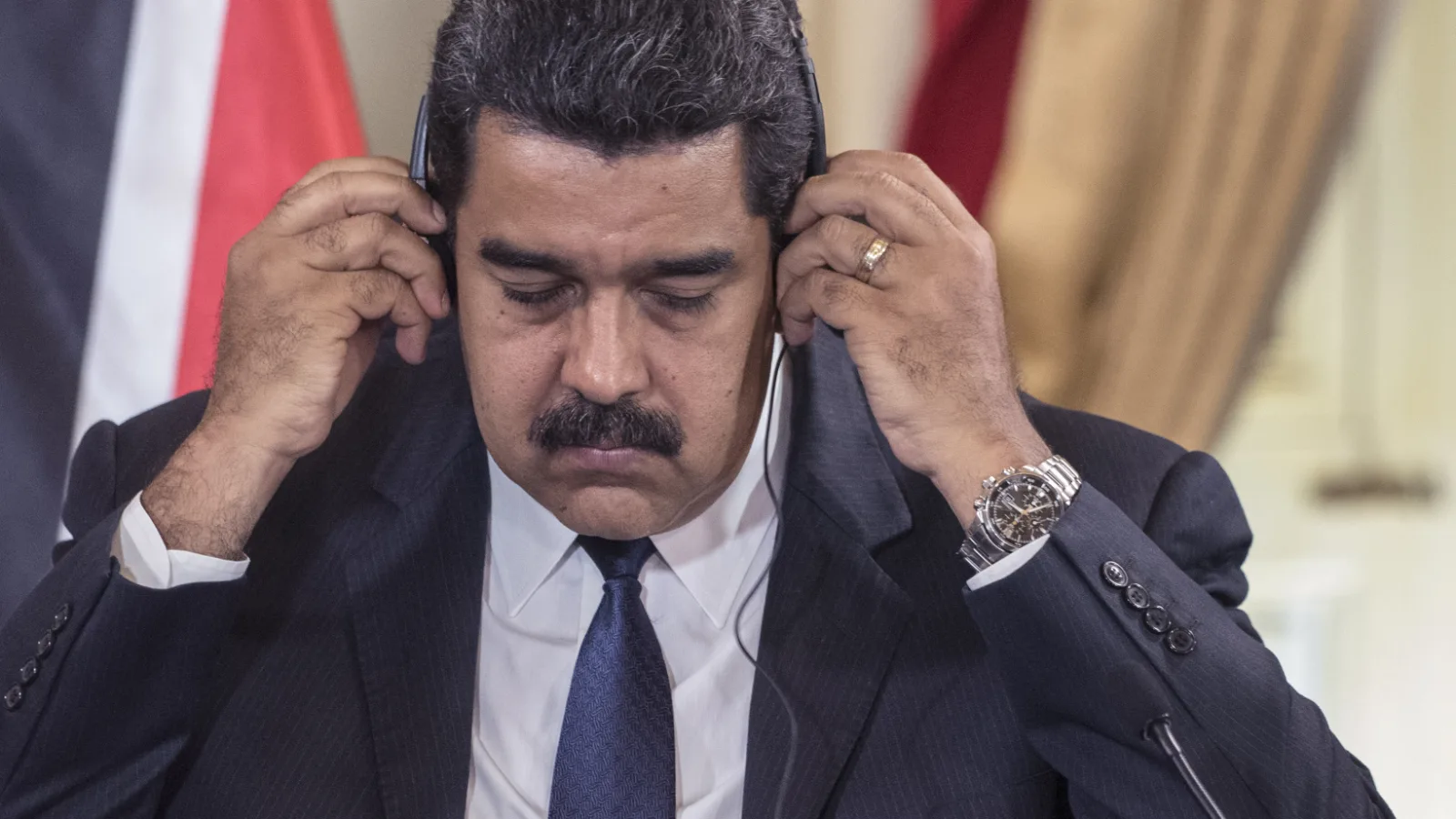
Nicolas Maduro
Photo: Original photo by Eneas De Troya from Mexico City, México, CC BY 2.0

On 3 January 2026 US forces carried out strikes in Caracas and captured Venezuela’s President, Nicolás Maduro, and his wife, Cilia Flores. They were flown to New York, where they face US charges including narco-terrorism conspiracy, and pleaded not guilty. The US government described the action as a law enforcement operation against indicted fugitives and argued that Maduro, whose 2024 re-election was widely disputed, was not a legitimate head of state.

The UN Secretary-General said the action set a dangerous precedent and that the rules of international law had not been respected. At an emergency Security Council meeting on 5 January, Russia, China and many other states condemned it, several US allies questioned its legality while also criticising Maduro’s government, and a few states welcomed it. No resolution was put to a vote. In Venezuela, Maduro’s vice-president, Delcy Rodríguez, became acting president, and the United States went on to work with her government.
  • On 3 January 2026 US forces carried out strikes in Caracas and captured President Nicolás Maduro and his wife, Cilia Flores, who were taken to New York.
  • US officials said more than 150 aircraft were used to disable Venezuelan air defences and that no American troops were killed. Venezuelan officials gave a preliminary estimate of at least 80 deaths, including civilians and members of the security forces.
  • A new indictment unsealed in the federal court for the Southern District of New York charges Maduro with narco-terrorism conspiracy, cocaine-importation conspiracy and weapons offences. Flores and other senior Venezuelan figures are also charged. Earlier US charges against Maduro were announced in March 2020.
  • At their first court appearance on 5 January 2026, before Judge Alvin Hellerstein, Maduro and Flores pleaded not guilty to all charges.
  • At the Security Council the US ambassador, Mike Waltz, called the action a “surgical law enforcement operation” carried out under indictments that had existed for years. He said Maduro was an illegitimate president and “not a head of state”, compared the case with the arrest of Panama’s Manuel Noriega in 1989, and said: “We are not occupying a country.”
  • Waltz said more than 50 countries did not recognise Maduro as Venezuela’s legitimately elected president. He did not refer to self-defence under Article 51 of the UN Charter.
  • The US Secretary of State, Marco Rubio, also described the operation as law enforcement, and the administration argued that Congress did not need to be notified in advance. President Trump said the United States would “run” Venezuela.
  • On 3 January the UN Secretary-General, António Guterres, said through his spokesperson that he was deeply alarmed, that the developments set a dangerous precedent and that he was concerned the rules of international law had not been respected.
  • Article 2(4) of the UN Charter requires all members to refrain from the threat or use of force against the territorial integrity or political independence of any state.
  • The Security Council held an emergency meeting on 5 January 2026, requested by Colombia; Venezuela had also asked for one, with the support of China and Russia.
  • At the meeting the Secretary-General’s statement, read by Rosemary DiCarlo, said he was deeply concerned that the rules of international law had not been respected, and recalled the Charter’s prohibition of the threat or use of force.
  • Russia warned against letting the United States act as “some kind of a supreme judge”, and China condemned what it called “unilateral, illegal and bullying acts”.
  • The United Kingdom said it wanted a safe and peaceful transition to a legitimate government, criticised the Maduro government’s record and reaffirmed its commitment to international law. France said the 2024 election had lacked transparency but that the operation “chips away at the international order”.
  • Argentina praised the US action, Paraguay called Maduro’s government a threat to the region, and Trinidad and Tobago supported US-led efforts against transnational crime. Mexico said the action violated the Charter, and Uganda, speaking for the Non-Aligned Movement, called it an act of war.
  • The UN’s record of the 5 January meeting reports no draft resolution or vote.
  • Brazil’s President Lula said the bombing and the capture of Venezuela’s president “cross an unacceptable line”. Argentina’s President Milei welcomed the news, and the EU’s foreign policy chief, Kaja Kallas, said Maduro lacked legitimacy but that the UN Charter must be respected.
  • The Organization of American States’ Permanent Council held an extraordinary session on 6 January 2026. The US described the operation as the arrest of a criminal leader, not an invasion; Argentina and Paraguay welcomed it, while Brazil and Colombia criticised it. No resolution was reported.
  • Maduro’s vice-president, Delcy Rodríguez, was sworn in as acting president on 5 January 2026 in a ceremony overseen by the National Assembly’s president, Jorge Rodríguez.
  • By early April 2026 the US Treasury had lifted sanctions on Rodríguez and authorised Venezuela’s state oil company to sell oil to US companies and on world markets.
  • In July 2026 Judge Hellerstein set Maduro’s trial for 1 June 2027. Judge Hellerstein died, aged 92, in late October 2026.
  • The opposition leader María Corina Machado returned to Venezuela on 25 October 2026. At that point Rodríguez remained acting president and no presidential election had been scheduled.
Maduro’s capture and what followed, 2026–27
  1. 3 January 2026US strikes in Caracas; Maduro and Flores captured and taken to New York. The Secretary-General warns of a dangerous precedent.
  2. 5 January 2026Emergency Security Council meeting; no resolution put to a vote. Maduro and Flores plead not guilty. Delcy Rodríguez sworn in as acting president.
  3. 6 January 2026Extraordinary session of the Organization of American States’ Permanent Council.
  4. By early April 2026US lifts sanctions on Rodríguez and allows Venezuela’s state oil company to sell to US companies.
  5. July 2026Trial date set for 1 June 2027.
  6. 25 October 2026Opposition leader María Corina Machado returns to Venezuela; no presidential election scheduled.
  7. Late October 2026Judge Alvin Hellerstein, who was overseeing the case, dies.
  8. 1 June 2027Scheduled start of Maduro’s trial.

Why is it politically significant?

The case raises a central question about national sovereignty: whether a state may use force in another state’s territory to seize its leader. The UN Charter prohibits the threat or use of force against another state’s political independence, and the US did not cite any Security Council authorisation. It argued instead that the operation was law enforcement against a leader it did not regard as legitimate.

It also shows the limits of the UN when a permanent member acts. Most speakers at the Security Council, including some US allies, said the Charter must be respected, but the Council took no decision, and any resolution criticising the United States could have been vetoed. The response came through statements, regional debate at the Organization of American States and US courts rather than through collective action.

How to use

Which arguments does it support?

Hard power allows major states to act regardless of the sovereignty of weaker states

Reasoning
A state with overwhelming military capability can carry out an operation that the target state cannot prevent.
Evidence
US officials said more than 150 aircraft were used to disable Venezuela’s air defences, and Maduro was removed from Caracas and brought before a US court.
How it supports the argument
Military and legal power together achieved the removal of a sitting government’s leader without the consent of that state.

The UN Security Council cannot act when a permanent member is involved

Reasoning
Each permanent member can veto any resolution, so the Council cannot take action against one of them.
Evidence
The Secretary-General said international law had not been respected and many members criticised the operation, but the meeting ended with no draft resolution or vote.
How it supports the argument
Widespread criticism in the Council did not lead to any collective decision.

Realism helps to explain the United States’ action

Reasoning
Realists argue that states pursue their own security and interests and that international law constrains great powers only weakly.
Evidence
The US ambassador cited the protection of Americans and objected to the world’s largest energy reserves being under the control of US adversaries.
How it supports the argument
The stated reasons were national security and interest, and the action went ahead despite objections based on the Charter.

The principle of non-intervention still has wide support

Reasoning
Liberals argue that rules and institutions shape how states justify what they do, even when the rules are broken.
Evidence
Russia, China, Brazil, Mexico and the Non-Aligned Movement condemned the action, and US allies such as France and Denmark said it undermined the international order, even though several of them did not regard Maduro as legitimate.
How it supports the argument
Many states defended sovereignty and the Charter while criticising the Maduro government, and the United States presented its case in legal terms rather than rejecting the rules.

Which counterarguments exist?

Alternative view

The US says this was law enforcement, not an attack on Venezuela

The US government argued that the operation enforced long-standing indictments against an individual who was not a legitimate head of state, pointing to the disputed 2024 election and the more than 50 countries that did not recognise Maduro. It compared the case with the arrest of Manuel Noriega in 1989 and said it was not at war with Venezuela or occupying it. Argentina and Paraguay welcomed the outcome, and several critics of the operation, including the UK, France and the EU, also said Maduro lacked legitimacy.

A different conclusion

The UN still mattered as a forum

Even without a resolution, the Security Council meeting made states set out their positions in public, and the United States chose to defend its action there in terms of law. This could support the view that the Charter still shapes the debate, even when it does not stop a permanent member.

Limits of the evidence

Key facts and the legal case are not settled

Casualty figures are preliminary estimates reported from Venezuelan officials, and accounts of the operation come mainly from news reports. The charges against Maduro are allegations that have not been tested at trial, which is scheduled for 2027.

Other explanations

The outcome inside Venezuela was limited

Maduro’s removal did not bring the opposition to power: his vice-president became acting president, the United States chose to work with her government, and by November 2026 no presidential election had been scheduled. This suggests limits to what hard power alone can achieve.

Concepts and connections

Sources and verification

Event3 January 2026 (US operation); 5 January 2026 (Security Council meeting)
Added to bank8 November 2026
Last checked8 November 2026
Next check due8 May 2027
  1. 3Source to check
  2. 12
    Publisher United States Mission to the United NationsPublished 2026-01-05Type OfficialChecked not yet opened
    Source to check
  3. 2
    Publisher United NationsPublished 2026-01-03Type OfficialChecked not yet opened
    Source to check
  4. 15
    Publisher United Nations in Trinidad and TobagoPublished 2026-01-05Type OfficialChecked not yet opened
    Source to check
  5. 16
    Publisher UN NewsPublished 2026-01-05Type OfficialChecked not yet opened
    Source to check
  6. 1
    Publisher Security Council ReportPublished 2026-01-04Type ReportChecked not yet opened
    Source to check
  7. 11
    Publisher NPRPublished 2026-01-03Type NewsChecked not yet opened
    Source to check
  8. 4
    Publisher NPRPublished 2026-01-05Type NewsChecked not yet opened
    Source to check
  9. 13
    Publisher NPRPublished 2026-01-04Type NewsChecked not yet opened
    Source to check
  10. 5
    Publisher Al JazeeraPublished 2026-01-05Type NewsChecked not yet opened
    Source to check
  11. 17
    Publisher AxiosPublished 2026-01-03Type NewsChecked not yet opened
    Source to check
  12. 6
    Publisher El DiarioPublished 2026-01-06Type NewsChecked not yet opened
    Source to check
  13. 18
    Publisher Kaieteur NewsPublished 2026-01-07Type NewsChecked not yet opened
    Source to check
  14. 7
    Publisher NPRPublished 2026-04-02Type NewsChecked not yet opened
    Source to check
  15. 8
    Publisher Al JazeeraPublished 2026-07-22Type NewsChecked not yet opened
    Source to check
  16. 10
    Publisher DawnPublished 2026-10-29Type NewsChecked not yet opened
    Source to check
  17. 9
    Publisher PBS NewsHourPublished 2026-10-25Type NewsChecked not yet opened
    Source to check
  18. 14
    Publisher United NationsPublished 1945Type Primary textChecked 4 November 2026
    Opened

About this example

Is it still current?

Developing

At the last check Maduro’s trial in New York was set for 1 June 2027, Delcy Rodríguez remained Venezuela’s acting president and no presidential election had been scheduled.

Why it is in the bank

A recent and much-debated case of military intervention against a sitting leader, testing state sovereignty, international law and the limits of the Security Council.

  • ✓Relevance to the specification
  • PartlyStrength and reliability of the evidenceDetails of the operation, the charges and later events come from news reports; the court records were not opened. The OAS session is reported by regional news outlets rather than the OAS’s own record, which could not be opened in this run.
  • ✓Importance to a wider political debate
  • ✓Usefulness in evaluative essays
  • ✓Connections to other topics
  • ✓Sufficiently current
  • ✓Adds something new to the bank

Editorial status

Approved

Signed off for students.

Origin: Human-written · Reviewer: Editor

Every fact on this page has been checked against original sources.