Crossbench
ApprovedCurrentInternational
Title

NATO’s Ankara summit reaffirms collective defence amid transatlantic tensions

Date
7–8 July 2026
Relevant topic(s)
Global governance: politicalPolitical: the United Nations and NATOGlobal governance: politicalHow far these institutions address and resolve contemporary global issuesPower and developmentsDiffering significance of states in global affairsPower and developmentsPolarityComparative theoriesMain ideas of realismComparative theoriesHow far realism and liberalism explain developments since 2000

What happened?

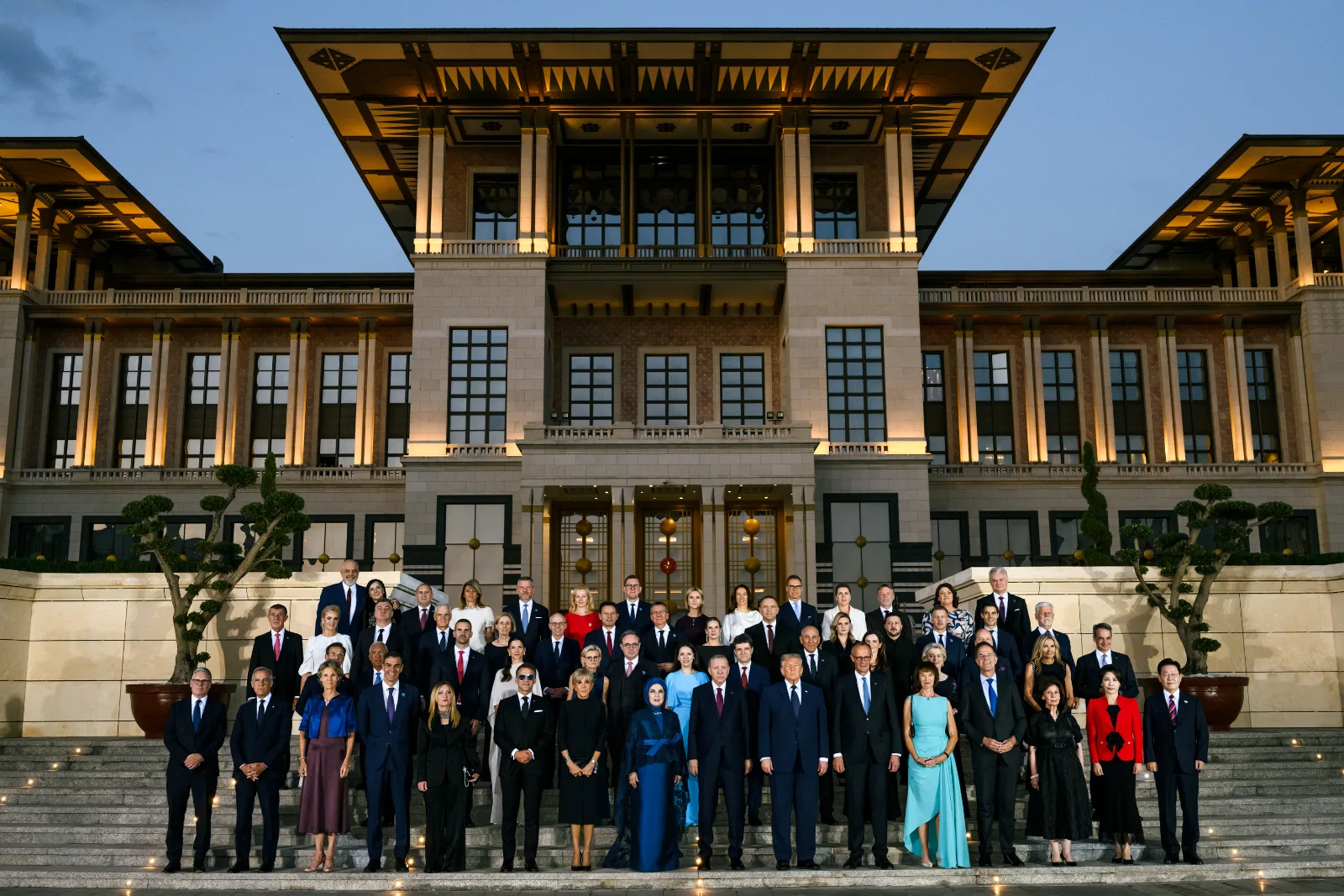
NATO Ankara summit family photo
Photo: Original photo by The White House, Public Domain Mark 1.0

NATO leaders met in Ankara, Türkiye, on 7–8 July 2026, a year after agreeing at The Hague that allies would raise defence and security spending to 5% of GDP by 2035. Their declaration was six paragraphs long. It restated the Article 5 pledge that “an attack on one is an attack on all”, named Russia as a long-term threat, reported that European allies and Canada had raised core defence investment by more than $139 billion in 2025, and pledged €70 billion of military support to Ukraine for 2026.

The summit took place during tensions between the United States and some allies. News organisations reported that President Donald Trump criticised allies over the war with Iran and renewed his call for US control of Greenland, part of Denmark, before describing the meeting as a success with “a lot of unity”. NATO’s own figures showed that five allies were expected to meet the 3.5% core defence level in 2026.

  • The summit was held at the Beştepe Presidential Complex in Ankara on 7–8 July 2026, with the North Atlantic Council meeting at the level of heads of state and government on 8 July.
  • The Ankara Summit Declaration reaffirmed allies’ commitment to collective defence under Article 5 of the Washington Treaty, stating that “an attack on one is an attack on all”.
  • At The Hague in June 2025, allies agreed to invest 5% of GDP a year by 2035: at least 3.5% on core defence requirements and up to 1.5% on defence- and security-related spending such as protecting critical infrastructure, with the path to be reviewed in 2029.
  • The Ankara declaration said allies were delivering on the Hague commitment, that European allies and Canada had increased core defence investment by more than $139 billion in 2025, and that more than $50 billion in new procurements had been announced.
  • NATO said five allies were expected to meet the 3.5% core defence guideline in 2026 and 17 allies the 1.5% defence- and security-related guideline.
  • According to NATO estimates reported by Reuters and ICDS, the five allies above 3.5% in 2026 were Lithuania (5.33%), Estonia (about 5.1%), Latvia (4.92%), Poland (4.68%) and Greece (3.65%). The estimate for the UK was 2.56%, for the United States 3.17%, and for European allies and Canada combined 2.53%.
  • The declaration named “the long-term threat Russia poses to Euro-Atlantic security and stability” and the persistent threat of terrorism. It did not mention China.
  • Allies pledged €70 billion in military equipment, assistance and training for Ukraine in 2026 and committed to at least equivalent levels in 2027. The declaration said European allies and Canada now provide most security assistance to Ukraine.
  • AP reported that the United States would not contribute to the Ukraine package. President Trump said the US would license Patriot air defence systems to be built for Ukraine.
  • The UK government said around a dozen European allies, in an initiative led by the UK, were expected to spend more than $50 billion over ten years on deep precision strike weapons able to reach targets at least 300km away, with UK commitments including £3 billion by 2030 for British capabilities.
  • Breaking Defense reported that NATO planned to buy up to ten Swedish GlobalEye surveillance aircraft to replace its ageing E-3 fleet.
  • President Trump renewed his call for US control of Greenland; Danish Prime Minister Mette Frederiksen said the island was not for sale.
  • Al Jazeera reported that Trump said he was “very upset with NATO” and criticised Spain, which had refused to let the US use its bases for operations against Iran.
  • After the meeting Trump told reporters there was “a lot of love in that room. A lot of unity.”
  • The declaration gave no date or place for the next summit. AP reported that NATO Secretary General Mark Rutte confirmed Albania would host it, with the timing still to be decided.

Why is it politically significant?

The summit is evidence for debates about how far NATO addresses contemporary security issues. Allies restated the collective defence guarantee, named Russia as the main long-term threat and recorded large increases in European spending, but only five allies were expected to meet the new core level in 2026.

It also shows the changing balance of power inside the alliance. European allies and Canada now provide most military help to Ukraine and the declaration describes them as taking on greater responsibility for defence, while disputes with the United States over Greenland and Iran raise questions about whether the US commitment to its allies is as firm as before.

How to use

Which arguments does it support?

NATO remains an effective collective defence alliance

Reasoning
Collective defence depends on a credible promise that allies will defend one another.
Evidence
All 32 allies restated the Article 5 pledge and reported that European allies and Canada raised core defence investment by more than $139 billion in 2025.
How it supports the argument
Despite public disagreements, members kept the core guarantee and backed it with higher spending.

States form alliances to balance a threatening power

Reasoning
Realists argue that states respond to threats by building up their own forces and combining with others.
Evidence
The declaration named Russia as the long-term threat to Euro-Atlantic security, and the highest 2026 spending estimates were for Lithuania, Estonia, Latvia and Poland.
How it supports the argument
Realists would expect the states that feel most exposed to Russia to spend most, and to rely on the alliance for extra security.

Power within the Western alliance is shifting away from the United States

Reasoning
Debates about polarity ask whether the US still leads the West as it did after the Cold War.
Evidence
European allies and Canada now provide most security assistance to Ukraine, and AP reported that the US would not contribute to the €70 billion package.
How it supports the argument
Europe is taking on burdens that the United States previously carried, which may point to a less US-centred alliance.

Which counterarguments exist?

Alternative view

Divisions weaken the credibility of the guarantee

Critics point to President Trump’s reported attacks on allies, his renewed push for US control of Greenland, and talk among some allies of avoiding another divisive summit. On this view, an alliance whose leading member questions its partners is less dependable than its declaration suggests.

Limits of the evidence

Spending targets are far from met

NATO’s own estimates showed only five of 32 allies at the 3.5% core level in 2026, and the combined figure for European allies and Canada was reported at about 2.5%. The 2035 deadline leaves time, but the gap is large and the trajectory is due to be reviewed in 2029.

A different conclusion

A short declaration can reflect agreement, not weakness

Breaking Defense judged that a calm summit eased earlier worries about US engagement, and Trump himself called it a success. On this view, a short text focused on defence, industry and Ukraine kept all allies, including the United States, signed up to the same commitments.

Other explanations

Liberal explanations also fit

Liberals would stress that the alliance works through shared institutions, joint procurement and long-term commitments to Ukraine, not just a balance of power, and that cooperation continued despite disputes between governments.

Concepts and connections

Sources and verification

Event7–8 July 2026
Added to bank8 November 2026
Last checked8 November 2026
Next check due8 May 2027
  1. 2
    Publisher NATOPublished 2026-07-08Type OfficialChecked not yet opened
    Source to check
  2. 1
    Publisher NATOPublished 2026-07-08Type OfficialChecked not yet opened
    Source to check
  3. 4
    Publisher NATOPublished 2026-07-07Type OfficialChecked not yet opened
    Source to check
  4. 3
    Publisher Office of the President of the Republic of Finland (text of the NATO declaration)Published 25 June 2025Type OfficialChecked 4 November 2026
    Opened
  5. 5
    Publisher Reuters (republished by Internazionale)Published 2026-07-07Type NewsChecked not yet opened
    Source to check
  6. 6
    Publisher International Centre for Defence and Security (ICDS)Published 2026-07-09Type ReportChecked not yet opened
    Source to check
  7. 7
    Publisher Associated Press (via WTOP)Published 2026-07-08Type NewsChecked not yet opened
    Source to check
  8. 8
    Publisher Al JazeeraPublished 2026-07-08Type NewsChecked not yet opened
    Source to check
  9. 10
    Publisher Breaking DefensePublished 2026-07-10Type NewsChecked not yet opened
    Source to check
  10. 9
    Publisher Prime Minister’s Office, 10 Downing Street (GOV.UK)Published 2026-07-08Type OfficialChecked not yet opened
    Source to check

About this example

Is it still current?

Current

The facts and their significance still stand.

Why it is in the bank

The most recent NATO summit, showing collective defence, burden-sharing and US–European tensions in one event.

  • ✓Relevance to the specification
  • PartlyStrength and reliability of the evidenceNATO’s 2026 defence expenditure report could not be opened in this run, so the figures for individual allies come from Reuters and ICDS reports of NATO’s estimates. Trump’s criticism of Spain comes from a single news report.
  • ✓Importance to a wider political debate
  • ✓Usefulness in evaluative essays
  • ✓Connections to other topics
  • ✓Sufficiently current
  • ✓Adds something new to the bank

Editorial status

Approved

Signed off for students.

Origin: Human-written · Reviewer: Editor

Every fact on this page has been checked against original sources.